Dienstag, 20. April 2010
Institutionalised Religion
sos67, 19:22h
For brevities' sake, spirituality, an immaterial world based upon thought, opposed to the material world, or even simpler, reality.
Institutionalised in this sense is just a dogmatic, male oriented hierarchal structure designed to control thought via implementation of fear, simply for the sake of power.
The Beginning or the Escape Hatch
In the course of dealing with survival and the realisation that reality definately results in death, our prehistoric ancestors were compelled to develop a spiritual escape hatch, mainly to deal with the fear of death and the question: "What next?".

The only way to concquer fear is through culture. The earliest recorded cultural activities were practised by neanderthals who ritually buried their dead, placing instruments along with other objects into the graves. This practise shows nothing more than the living expressing their respect for the deceased by ceremoniously interring them, being confronted with the finity of life.
Well, caves were small and corpses pile up and develop quite an off color aroma, hence the only way to honor their spirit and not have the bodies eaten by crows and being passed through various other scavengers' bowels consequently resulted in a quick burial. And along with the body a few give away presents, maybe the stuff belonged to the deceased and they were plain scared of the stuff, maybe they even used the stuff to identify themselves during lifetime. Who knows?
One indian culture in the Amazon still sees it as its task to burn the deceased, mix the ashes with banana stew and a couple of hallucinogens, then ceremoniously enjoy the meal. They see it as their job to collectively internalise the souls of their ancestors. They see the deads' only logical dwelling in the living, not buried in the ground, makes absolutely no sense to them, denying the soul of the deceased a home in a living being equals denying eternal life.
A simple model of the escape hatch: in order to conquer the fear of death and the "what next?" question you have to invent spirituality.
(Nowadays spirituality is primarily used as a cover up to gain and maintain power.)
The only realistic counterparts to death and decay are fertility and life, represented by various cults respectively.
I d even dare to say that ritual killing and slaughtering of virgins and animals, mainly during a famine or just for kicks,
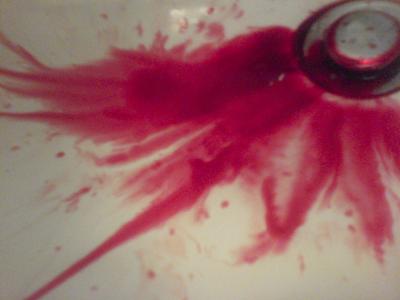
results from the idea or even logical conclusion that blood represents fertility. A girls' first menstruation, ie. blood flows, fertility follows, must have had an awsome effect on her male counterparts. That they took it literally, escapes my imagination; fertile virgins were slain while the priests were invoking a god, then offering the sacrifice in the exact opposite condition the invoked deity represents. Now what use is a dead virgin to fertility god, provided he doesnt represent murder or necropheliac ideals ?
Great, no need to be rational, but just enough to understand that our cultural and genetic heritage still holds a lot of that behaviour in our grey matter.

Institutionalised in this sense is just a dogmatic, male oriented hierarchal structure designed to control thought via implementation of fear, simply for the sake of power.
The Beginning or the Escape Hatch
In the course of dealing with survival and the realisation that reality definately results in death, our prehistoric ancestors were compelled to develop a spiritual escape hatch, mainly to deal with the fear of death and the question: "What next?".
The only way to concquer fear is through culture. The earliest recorded cultural activities were practised by neanderthals who ritually buried their dead, placing instruments along with other objects into the graves. This practise shows nothing more than the living expressing their respect for the deceased by ceremoniously interring them, being confronted with the finity of life.
Well, caves were small and corpses pile up and develop quite an off color aroma, hence the only way to honor their spirit and not have the bodies eaten by crows and being passed through various other scavengers' bowels consequently resulted in a quick burial. And along with the body a few give away presents, maybe the stuff belonged to the deceased and they were plain scared of the stuff, maybe they even used the stuff to identify themselves during lifetime. Who knows?
One indian culture in the Amazon still sees it as its task to burn the deceased, mix the ashes with banana stew and a couple of hallucinogens, then ceremoniously enjoy the meal. They see it as their job to collectively internalise the souls of their ancestors. They see the deads' only logical dwelling in the living, not buried in the ground, makes absolutely no sense to them, denying the soul of the deceased a home in a living being equals denying eternal life.
A simple model of the escape hatch: in order to conquer the fear of death and the "what next?" question you have to invent spirituality.
(Nowadays spirituality is primarily used as a cover up to gain and maintain power.)
The only realistic counterparts to death and decay are fertility and life, represented by various cults respectively.
I d even dare to say that ritual killing and slaughtering of virgins and animals, mainly during a famine or just for kicks,
results from the idea or even logical conclusion that blood represents fertility. A girls' first menstruation, ie. blood flows, fertility follows, must have had an awsome effect on her male counterparts. That they took it literally, escapes my imagination; fertile virgins were slain while the priests were invoking a god, then offering the sacrifice in the exact opposite condition the invoked deity represents. Now what use is a dead virgin to fertility god, provided he doesnt represent murder or necropheliac ideals ?
Great, no need to be rational, but just enough to understand that our cultural and genetic heritage still holds a lot of that behaviour in our grey matter.
... comment